

SCIENTIFIC EVIDENCE | 1-MINUTE READ
Published: March 2026
Artificial intelligence and working length: what did researchers investigate?
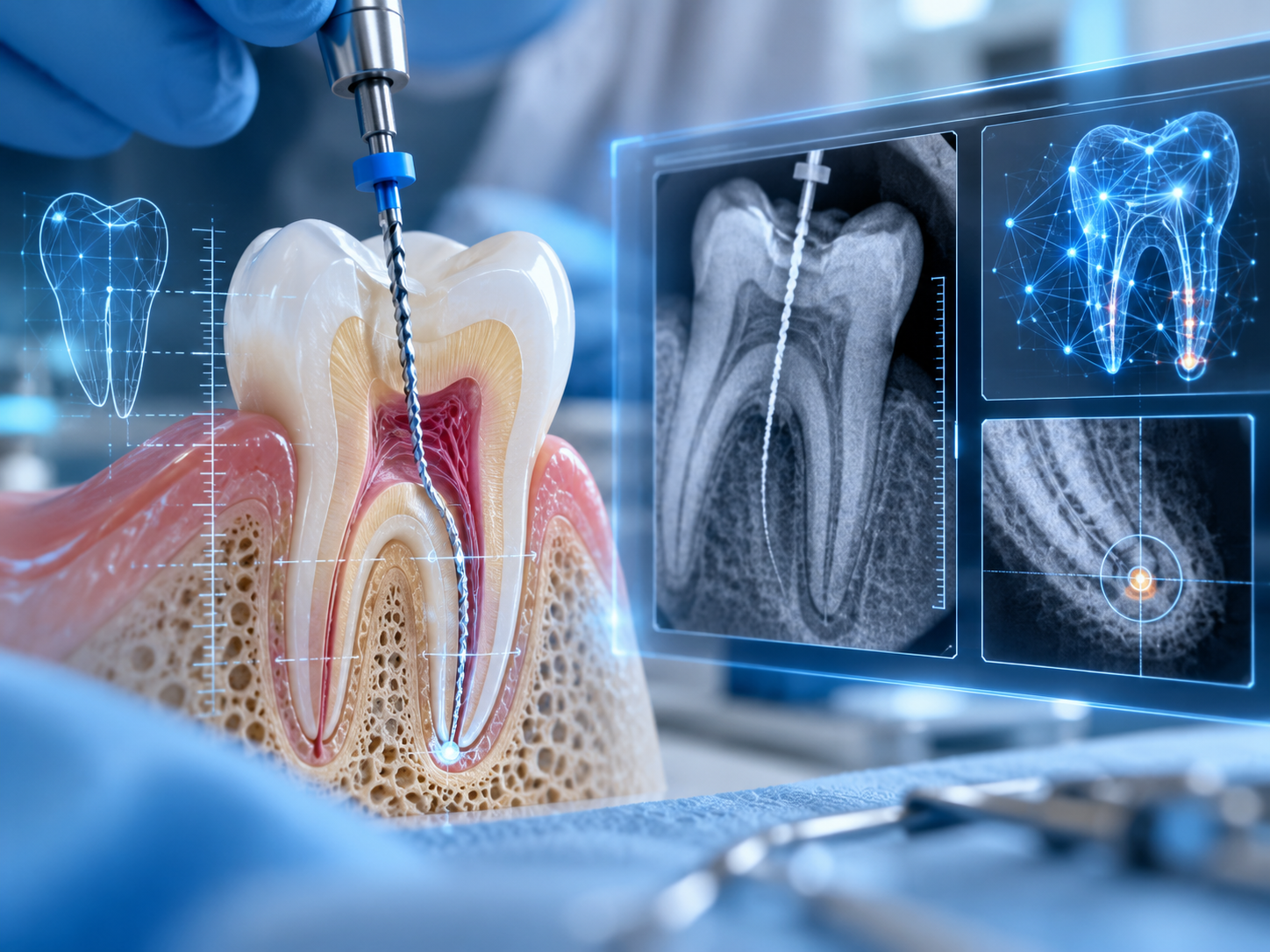
A systematic review evaluated the performance of artificial intelligence models for working length determination in endodontics and identification of related apical anatomical landmarks.
The review included 6 studies examining machine learning or neural network models using radiographic or impedance-based data. Methodological quality was assessed using QUADAS-2, and certainty of evidence was evaluated with GRADE.
What were the results?
3 key findings
- Reported performance: sensitivity ranged from 85% to 100%, specificity from 50% to 100%, and accuracy from 70% to 95% across studies.
- Insufficient validation: most studies relied on retrospective or experimental datasets with internal validation only. None reported prospective, real-world external validation.
- Low-certainty evidence: substantial differences in algorithms, outcome definitions and reference standards limited reliable comparisons between studies.
What does this mean for clinical practice?
Artificial intelligence in endodontics shows preliminary potential as an adjunct for working length determination.
However, the authors conclude that these systems should currently be regarded as experimental adjuncts, rather than clinically established replacements for conventional methods. Prospective multicenter studies with standardized outcome measures are needed.
Original article:
Performance of artificial intelligence models designed as adjuncts for determining working length and apical landmark assessment in endodontic procedures: a systematic review.
Authors: Sanjeev B. Khanagar et al.
Source: Read the original study