


CLINICAL GUIDELINE · ADA 2026
The American Dental Association (ADA), in collaboration with the University of Pennsylvania School of Dental Medicine, has updated its recommendations for the early detection of oral squamous cell carcinoma and oral potentially malignant disorders.
The 2026 update is part of a living clinical guideline program designed to incorporate new scientific evidence as it becomes available.
Fundamental principles
- Conventional visual and tactile examination remains essential.
- Biopsy remains the reference standard for establishing a definitive diagnosis.
- Adjunctive tests must not delay an indicated biopsy or referral.
- Most of the adjunctive tests evaluated are not recommended for routine use in deciding whether a biopsy is needed.
1. Initial Clinical Assessment
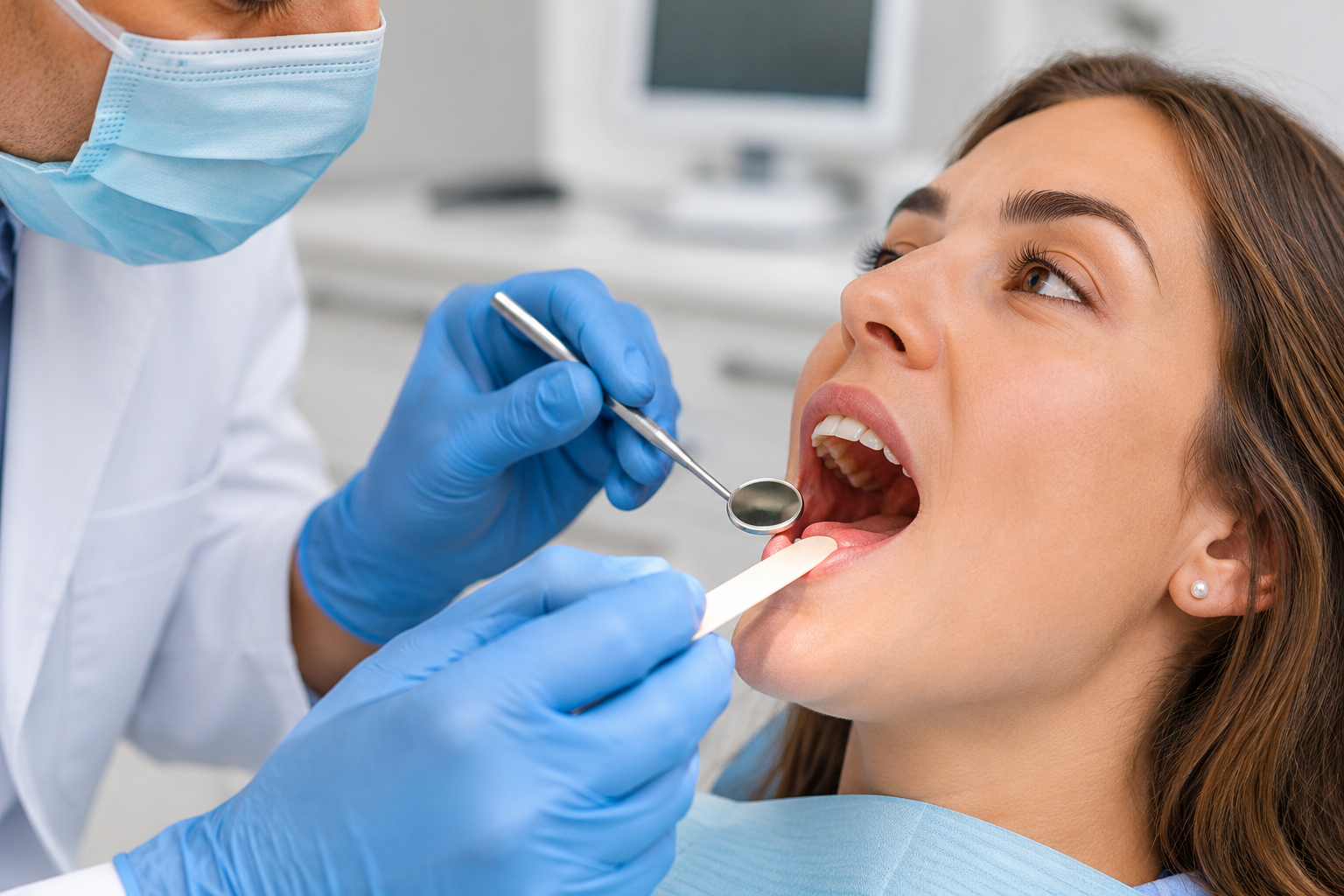
The ADA emphasizes the importance of conventional examination of the oral cavity and related structures during dental care.
The 2017 guideline recommendations, which provide the background for this update, include:
- Update the adult patient’s medical, dental and social history.
- Perform an intraoral and extraoral visual and tactile examination.
- Identify abnormalities of the oral mucosa and lips that require further evaluation.
- If a clinically suspicious lesion is identified, perform a timely biopsy or refer the patient to an appropriate specialist.
These principles remain relevant to the updated approach to early detection.
2. What Should Be Done When a Suspicious Lesion Is Found?
Clinical management supported by ADA guidance
Clinically suspicious lesion: biopsy or referral to a specialist for evaluation is indicated.
Persistent or progressive lesion: a negative cytology result does not exclude disease. If the abnormality persists or progresses, biopsy or referral is necessary.
Adjunctive tests: they must not be used to rule out a suspicious lesion or justify delaying a definitive diagnosis.
Biopsy and subsequent histopathological examination remain essential when the nature of a lesion must be established.
3. Oral Brush Cytology
Cytology involves collecting cells from an oral mucosal abnormality using a brush for subsequent analysis.
General recommendation: the ADA does not recommend routine use of adjunctive cytology tests to determine whether an adult with an oral or lip mucosal abnormality needs a biopsy or referral.
Limited exception: when biopsy is not feasible, advisable or indicated at that time, cytology may be offered to obtain additional information, particularly for clinically concerning abnormalities.
Fundamental limitation: a negative cytology result cannot definitively exclude a potentially malignant disorder or carcinoma. If the lesion persists or progresses, biopsy or referral is required regardless of the cytology result.
4. Vital Staining
Vital staining methods use dyes to help identify certain features of oral mucosal lesions.
ADA recommendation: these methods should not routinely be used to decide whether adults with visible oral or lip mucosal abnormalities require biopsy or referral.
They are also not recommended for determining the need for biopsy or referral in asymptomatic adults without clinically evident lesions.
The available evidence does not demonstrate sufficient accuracy to guide these decisions. Relying on such tests may result in unnecessary procedures or diagnostic delays.
5. Light-Based Devices
These devices use specialized light sources to help visualize mucosal changes that may not be readily distinguished under conventional illumination.
ADA recommendation: they should not routinely be used to determine whether an oral or lip abnormality requires biopsy or referral.
The recommendation also applies to screening asymptomatic adults without clinically evident lesions when the purpose is to decide whether biopsy or referral is needed.
Light-based devices do not replace conventional clinical examination or histopathological diagnosis.
6. Salivary Tests
Salivary tests are intended to detect biomarkers potentially associated with oral potentially malignant disorders or oral squamous cell carcinoma.
ADA recommendation: adjunctive salivary tests intended to inform decisions about biopsy or referral should be used only in research settings.
They should therefore not be presented as established substitutes for clinical examination or biopsy in the evaluation of suspicious lesions.
7. Summary of Clinical Recommendations
| Method | ADA guidance |
|---|---|
| Visual and tactile examination | Fundamental component of clinical assessment. |
| Biopsy | Reference standard for definitive diagnosis. |
| Cytology | Not routinely recommended to guide biopsy decisions; may be considered in limited circumstances. |
| Vital staining | Not routinely recommended for deciding on biopsy or referral. |
| Light-based devices | Not routinely recommended to determine the need for biopsy or referral. |
| Salivary tests | For this purpose, use should be restricted to research settings. |
8. What Changes With the 2026 Update?
The main change is not the replacement of clinical examination or biopsy with a new technology.
The update incorporates recent evaluations of evidence concerning four groups of adjunctive tests and presents recommendations through a living guideline system that allows them to be revised as new studies emerge.
The ADA also provides an interactive clinical guidance tool offering access to recommendations, supporting evidence and patient-centered considerations.
Important note for dental professionals
This article is an informational adaptation of the ADA recommendations published in 2026, together with relevant principles from its 2017 guideline. It is not an official translation and does not replace the original clinical guideline. As this is a living guideline, recommendations may change.
Official Sources and Documentation
Institution: American Dental Association (ADA).
Publication: Oral Cancer Guideline (2026 Update).
Scope: early detection of oral squamous cell carcinoma and oral potentially malignant disorders.
Full guideline:
Read the complete and updated ADA clinical guideline
Additional clinical information:
Read the ADA’s clinical information and references