

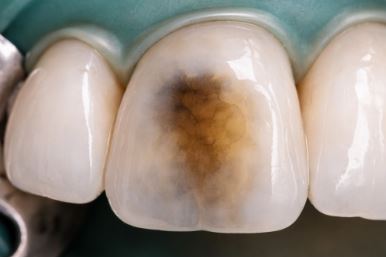
Internal bleaching (intracoronal bleaching) is a procedure used to improve the color of non-vital teeth that develop discoloration after endodontic treatment. This technique allows the tooth to be lightened without the need for more invasive restorative treatments such as veneers or crowns.
The procedure is based on the use of oxidizing agents that penetrate dental tissues and degrade organic pigments responsible for tooth discoloration.
The bleaching agents most commonly used for internal bleaching include hydrogen peroxide, carbamide peroxide and sodium perborate, all capable of releasing oxidizing radicals that act on pigments present in dentin.
Comparison between bleaching agents
Recent studies comparing different agents used for internal bleaching show differences in their whitening effectiveness.
In a comparative study, carbamide peroxide produced the greatest whitening effect, followed by hydrogen peroxide, while sodium perborate showed the lowest degree of whitening during the evaluated treatment period.
The study also reported statistically significant differences in color change, measured using colorimetric parameters such as ΔE, L, a and b***.
Recoloration after bleaching
Another important finding was that bleached teeth may show greater susceptibility to recoloration when later exposed to staining substances compared with teeth that had not undergone bleaching.
This phenomenon has been attributed to changes in the dental surface and dentin structure following the oxidation process.
Clinical implications
Recent scientific evidence suggests that the type of bleaching agent used can influence the degree of whitening obtained in non-vital teeth.
From a clinical perspective, these findings indicate that:
- different bleaching agents can produce different levels of tooth whitening
- carbamide peroxide may produce greater color changes in some internal bleaching protocols
- bleached teeth may be more susceptible to recoloration when exposed to staining substances
Therefore, the selection of the bleaching agent and control of staining factors after treatment may influence the aesthetic outcomes obtained.