

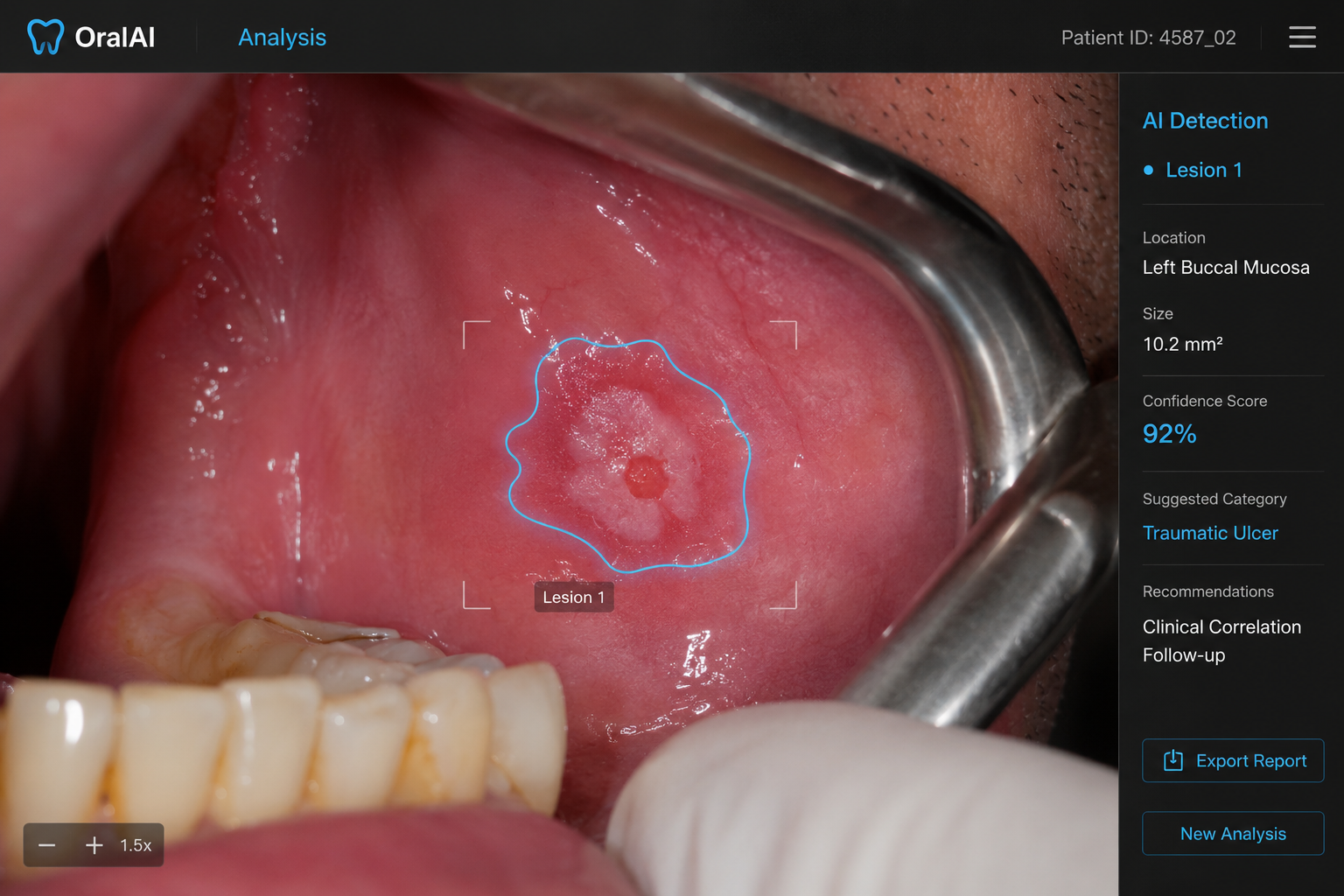
Summary in 1 minute
Multiple studies published in 2025 and 2026 demonstrate that deep learning models can detect malignant and potentially malignant oral lesions with high precision from clinical and histopathological images.
A study published in Scientific Reports (2025) trained DenseNet201 and FixCaps models with 518 oral cavity images for screening of potentially malignant lesions, showing promising results in automatic classification. In parallel, researchers from the Chinese PLA General Hospital developed a model based on a portable oral endoscope that captures intraoral images and analyzes them in real time using U-Net and ResNet-34 networks.
A particularly relevant development for clinical practice is a system published in Applied Sciences (2025) that combines a chatbot with convolutional neural networks for symptom triage and early detection, with an inference time of less than 5 seconds per image.
Another study in Expert Review of Medical Devices reported models achieving up to 99% specificity and 97.5% accuracy in classifying oral lesions from smartphone images.
Most of these systems are still in the validation phase, but the trend points toward accessible screening tools in the dental office that could complement conventional clinical examination.
Sources:
- Desai et al. Scientific Reports, 2025 — Read study
- Applied Sciences, 2025 — Read study